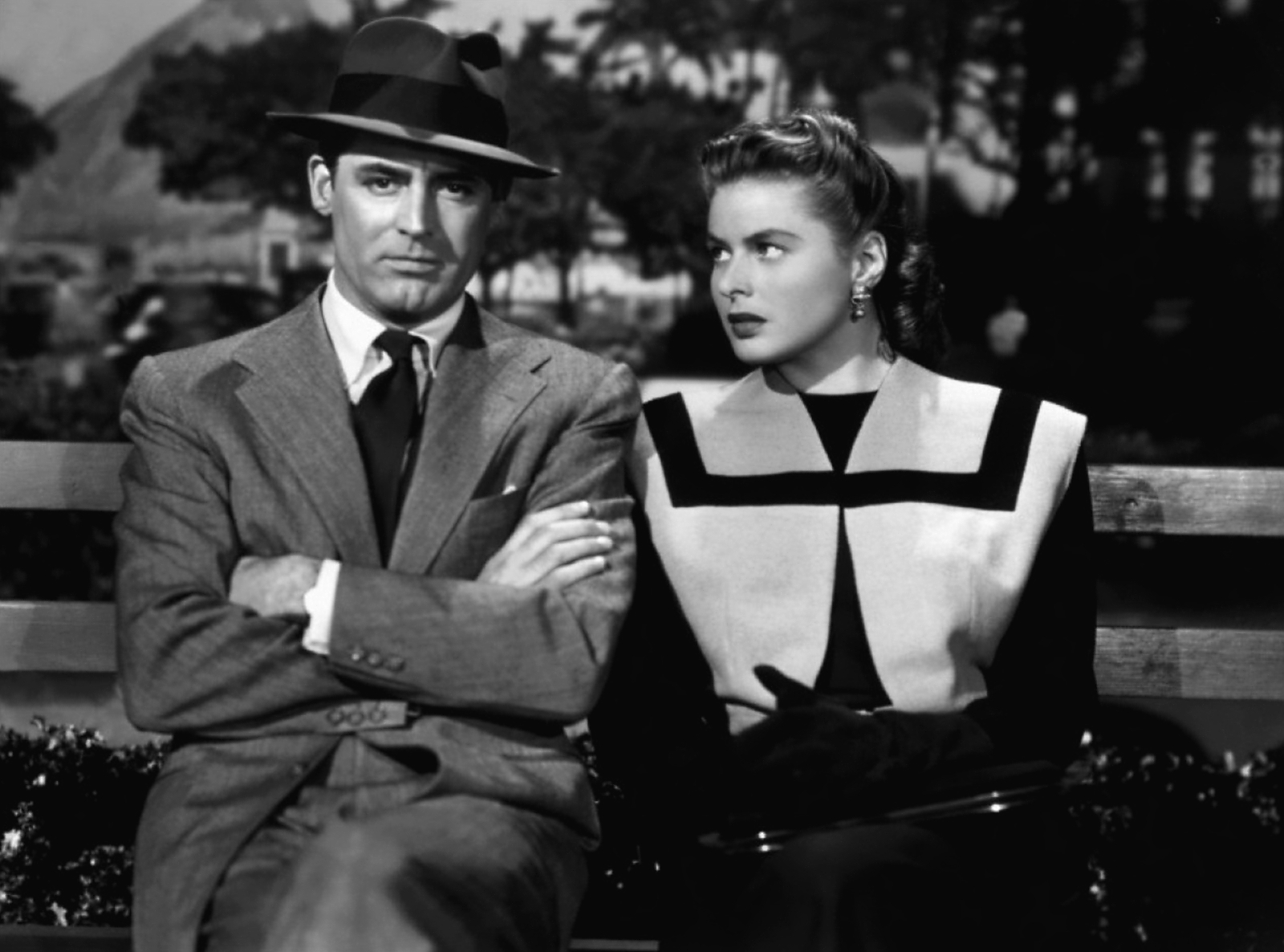
During the 1940s, morals and ethics played a large role in motion pictures. Hitchcock portrayed ethics in some very interesting ways in his films. In many scenes, he also found ways around being completely ethical, but still staying within the guidelines. Some specific parts where this can be seen in Notorious are in some of the women’s clothing, the kissing, alcohol and drunk driving, women being a part of an undercover job, and women participating in adultery.
The clothing that women wore throughout the 1940s was meant to form a sort of silhouette. Woman wore dresses with broad, wide shoulders and tight waist bands to form an hourglass shape. In Notorious, you can see that Alicia wears long, tight waisted dresses with square shoulders. This gives her an hourglass shaping to her body and makes her look professional. You can even see when she wears the suit on the airplane that it still follows these ideal aspects.
Throughout Notorious Alicia (Ingrid Bergman) and Devlin (Cary Grant) begin to become closer as they work together undercover. Eventually, the two find themselves in love. Of course being in love requires some kissing scenes, though this was difficult in the 1940s. The Production Code of 1930 was created to set some moral guidelines for motion pictures in the United States. This occurred during the period of Silent Movies switching to Sound. Due to the code, “Excessive and lustful kissing, lustful embraces, suggestive postures and gestures, were not to be shown.” This meant that even though they were in love, Ingrid and Cary could not show their characters’ true emotions. Hitchcock’s way around this was to have the couple do multiple short kisses, rather than one long kiss. Though it may look odd if you were to watch Notorious today, it was a very clever way around the rule then to be able to still show passion in his movies.
One scene portrayed in Notorious showed Alicia driving a car with Devlin after a party. The scene clearly shows Alicia is under the influence of alcohol as she is swerving all over the road and she cannot see straight. After World War II, the car market was on a rise. Everyone was buying cars and most drivers were uneducated. Laws prohibiting drunk driving began in 1910 but intoxication was not clearly defined at this point. In the 1930s lawmakers stated that a driver with a BAC of 0.15 percent or higher is inebriated. By the 1970s DUI laws become more strict and the legal drinking age was raised to 21. Today, drunk driving is an incredibly unethical action and a driver with a BAC of 0.08 percent is considered inebriated. In 2014, 9,967 people died and 290,000 people were injured in accidents due to drunk driving. In the 1940s, drunk driving may not have been seen as unethical as it is today because the laws that were placed then were not as strict as today. Also, less accidents had been reported then versus today.
In Notorious, we see one of the main characters, Alicia Huberman played by Ingrid Bergman, get thrown into the world of covert intelligence and spy business. What many don't know is that if this was actually set in the late 1940’s, Alicia might not be there. Women were not a big part of federal intelligence agencies during that time period, as far as field agents. Now during WWII, there was a substantial increase in women police officers, but even they were put on leash for what they could do while in the law enforcement. Indeed there were women in agencies, but they were doing desk work. Field agents were seen as a “thing only for boys”. It wasn't until 1972, that women were allowed to join FBI training. This goes to show that Alfred Hitchcock wanted to make his film stand out, and probably got heads to turn when they saw what a woman was doing in the film.
During the movie Notorious, after Alicia and Alex get married, Alex keeps suspecting her of having an affair with Devlin. Back in this time period, there was a different belief about marriages. They encouraged women to think of marriages as a successful career. They believed that it was the women's job to make sure the marriage was happy, his career was successful and that it didn’t end in divorce. Even if the problem in the marriage was alcohol or an affair from the men, it was the wife's job to change something to bring him back home. There was a thought back then that the wife was supposed to make the marriage work and nothing was her fault even if the man was having an affair. If a woman had an affair in the time period, it was much more taboo and less common than a man. If the woman had an affair it looked bad on the husband and not her.